FOOD BOOTH · Issue 006 · Coffee · Company · 2026.07
Four enterprises, four capabilities: how Baoshan coffee reaches the cup
From one bean to one cup of coffee — four cases showing how origin capability takes shape. We're not looking at which one is best, but at how much verifiable information each leaves behind.
Baoshan Small-Grain Coffee · Company Edition · Case review
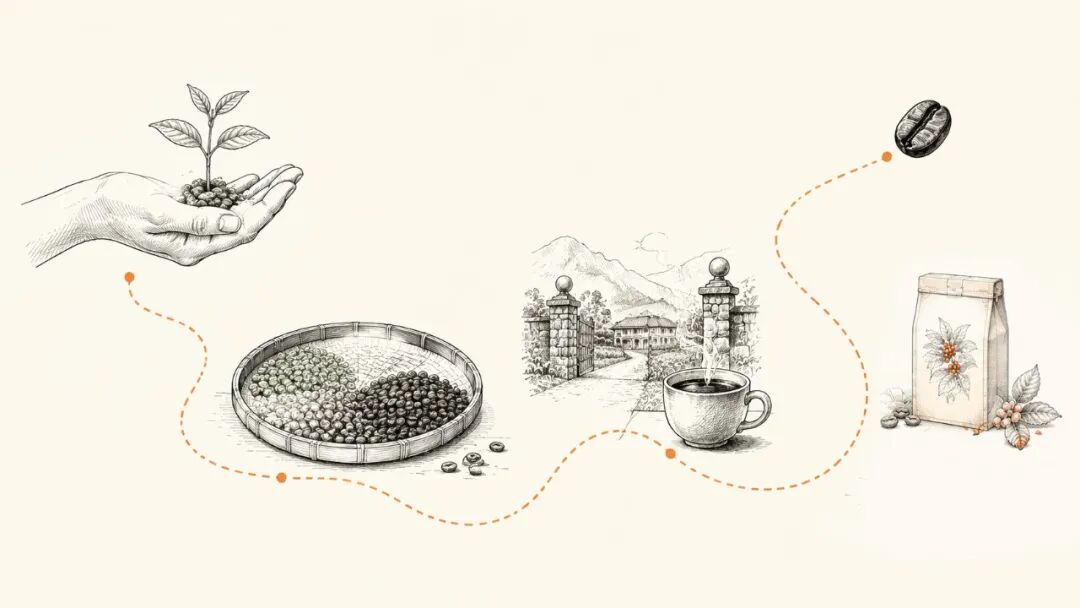
Figure · A cup of Baoshan small-grain coffee, from one bean to one cup
Many people have drunk #BaoshanSmallGrainCoffee without knowing how many steps a bean takes from origin to consumer.
In the previous piece we discussed the changes Baoshan's coffee industry is going through: from a raw-material origin toward a clearer origin identity. But that change ultimately has to be carried out by individual companies.
A cup of coffee's journey from Yunnan's red soil to the consumer's cup is a wondrous crossing of mountains and seas. The value it finally delivers depends not only on the flavor in the cup, but on the polishing of every link — variety choice, cultivation method, origin expression, and processing capability.
How exactly does this value transform? We selected four cases from Baoshan's 35 GI-authorized enterprises. Each enters from a different dimension, together sketching the full picture of Baoshan small-grain coffee's industrial upgrade.
1Baoshan Zhongka Food Co., Ltd. Breaking through from its own seed
Sample 01 / 04 · What consumers want to know
For a long time, #YunnanCoffee cultivation has relied mainly on introduced varieties, with hybrids like Catimor making up a large share. Does a coffee's flavor potential begin forming at the seed stage?
In Longyang District, Baoshan, Zhongka reaches different consumers precisely through a three-brand matrix — "Zhongka," "Xinlu," and "Black Diamond." Among them, "Xinlu" has ranked first in sales on mainstream e-commerce platforms' fresh-ground coffee category for five consecutive years. In 2025 the company achieved ¥270 million in sales, with online sales above 96%. That same year, Zhongka was awarded "National Leading Agricultural Industrialization Enterprise," achieving a "zero breakthrough" for Baoshan coffee at this honor level.
Behind its large market volume, Zhongka's deep investment upstream in the "variety" link is especially notable. For a long time Yunnan's coffee industry has been highly dependent on introduced varieties, lacking autonomy at the germplasm source. To break this bottleneck, Zhongka partnered with the Hot-Dry Regions Institute of the Yunnan Academy of Agricultural Sciences to successfully breed "Yunka No.1" (云咖一号), a specialty small-grain coffee variety with independent intellectual property.
"Yunka No.1" combines the excellent agronomic traits of high yield and disease resistance with distinctive floral and fruity notes. It has now been scaled up in Baoshan's core Lujiangba region. This means Baoshan is gradually shedding its dependence on foreign varieties and beginning to build a germplasm bank truly suited to local terroir.
At the processing and supply-chain end, Zhongka is likewise committed to raising industrial efficiency through technical innovation. It introduced an AI intelligent defect-removal line and "Fresh Shield" freshness-lock technology, greatly improving flavor consistency and quality stability in scaled specialty production. At the same time, Zhongka runs a "price-floor purchase + specialty premium" mechanism — in 2025 it bought nearly 2,000 tonnes of Baoshan specialty coffee above market price, directly benefiting over 10,000 farming households and returning the dividends of industrial upgrade to the land and the farmers.
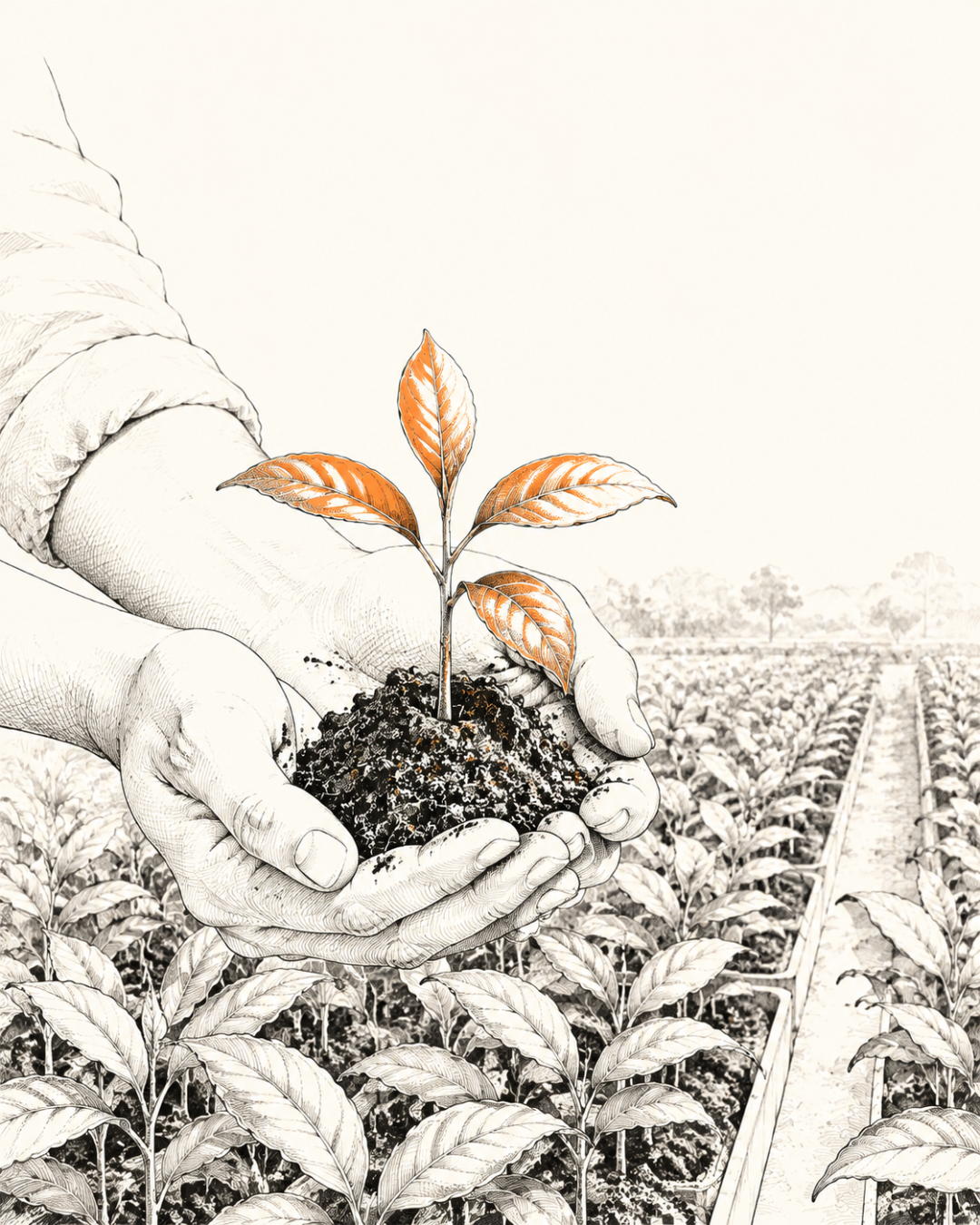
Figure · Zhongka's "seed-to-cup" chain, from Yunka No.1 breeding to AI defect-removal
FOOD BOOTH OBSERVATION · Sample 01 / 04
Zhongka presents one of the more complete "#seed-to-cup" chains among our samples, with a relatively high degree of brand openness; autonomous breeding is a key step for long-term competitiveness. But public materials still say little about "Yunka No.1"'s lineage (parent sources, specific cupping values). Further disclosure of breeding information would help the industry assess this variety's long-term potential more accurately. Online batch information and product traceability also have room to improve.
2Baoshan Xinzhai Coffee Industry (Xinzhai Village) A village that sold an old variety at a specialty price
Sample 02 / 04 · What consumers want to know
Why can Xinzhai's specialty green beans sell for several times the price of ordinary commercial beans?
The birth of a good cup of coffee is like a relay race of time and craft: when to pick, how to process the fruit, how to grade precisely, and whether the consumer can read the origin story behind it — every link adds value to the final cup. What Yunnan's Xinzhai Village did was reweave these scattered links into a tight value web.
Xinzhai Village sits in Lujiang Town, Longyang District, Baoshan — against Gaoligong Mountain to the west and the Nujiang River to the east, in the coffee golden belt at 24°N. With an average annual temperature around 21.5°C and a unique subtropical dry-hot valley climate, it is an ideal cradle for coffee trees. As "China's first coffee village" with over 70 years of cultivation history, Xinzhai has 13,600 mu of core coffee-growing area.
The "first village" also went through pain. The old extensive model was "priced by volume" — farmers grabbed red and green cherries together, picking and roasting them all at once. This led to uneven quality and long-depressed prices. At its hardest, green-bean purchase prices fell to ¥4 per kg, and an acre earned less than ¥300, pushing many villagers to cut down trees and switch crops.
The turning point came in 2016, when Xinzhai made a decisive pivot to "specialty," building an integrated "selection, planting, picking, processing" quality-management system.
On the cultivation side, the village heavily introduced quality varieties like Typica, Bourbon, and Gesha, reaching a 98% improved-variety coverage rate, and strictly controlled planting density so each tree gets full sun and rain. On the picking side, it enforced graded picking and graded pricing, leaving behind the crude "take-it-all" model. Today Xinzhai's specialty green-bean purchase price has jumped to ¥60–65 per kg, and its specialty rate soared from 10% (2021) to 80% (2025).
Behind this rigorous standard is strong organizational cohesion. The village formed 6 cooperatives practicing unified management, purchase, processing, and sales. Through a "village committee + enterprise + cooperative + base + household" "manor+" model, all 502 village households were tightly woven into the chain. Party members also led by planting demonstration plots, showing villagers the "money view" of specialty coffee.
More cleverly, Xinzhai turned coffee from a mere agricultural product into an "experiencable" lifestyle. The village built 6 specialty coffee manors and over 10 coffee-themed courtyards, launched distinctive coffee banquets, a coffee library and art museum, plus more than 10 derivative products like freeze-dried powder and drip bags. The village collective even built its own "Secretary's Coffee" brand. This deep "coffee-tourism fusion" let Xinzhai break free of its raw-material-origin limits. In 2024, per-capita disposable income reached about ¥40,000 — over 14 times that of 2012 — and its coffee products were exported as far as the Netherlands, Germany, and Vietnam.
FOOD BOOTH OBSERVATION · Sample 02 / 04
More than a single company, Xinzhai is an industrial sample. Only when a whole village builds mechanisms around grading, processing, and quality pricing can traditional varieties convert into farmers' income — a microscopic footnote to Baoshan's rising specialty rate. Whether a variety can fetch higher value ultimately depends on how mature the entire system — from planting and picking to sales — has become.
3Baoshan Bidun Coffee Co., Ltd. Letting trust arise naturally through experience
Sample 03 / 04 · What consumers want to know
Where exactly was that pack of coffee I bought grown, and how was it made?
For consumers, real trust often comes from "seeing is believing." What Bidun does is lay this production chain — usually hidden backstage — fully under the sun, letting every taster witness and take part in the product's birth, firsthand.
Bidun's story began in 2012, rooted in Baoshan's Lujiangba dry-hot valley. Unlike many brands rushing to build sales channels, Bidun's first stroke was a coffee manor with a view. This "Bidun Coffee Industry & Culture Park," backed by Gaoligong Mountain and facing the Nujiang River, is not just a production base but a national 4A-level tourist attraction. In 2024 it welcomed over 100,000 visitors eager to trace coffee to its source.
Here, coffee leads an immersive sensory journey. Bidun weaves planting, processing, experience, lodging, and study tours into one. Visitors can stroll gardens displaying Yunnan's representative coffee varieties, hand-pick a ripe red cherry under a professional barista's guidance, and experience every tiny moment from pulping to roasting, grinding, and brewing. From the touch on their fingertips to the aroma on their tongues, people truly understand a coffee's full life trajectory.
This "manor-style" transparent experience is not unique. In Baoshan's Longyang District there are already 17 coffee manors deeply integrating the primary, secondary, and tertiary industries, 6 of them rated as Yunnan specialty coffee manors. Together they form an open industrial ecosystem, letting consumers naturally build deep recognition of and trust in Yunnan coffee amid the green hills and clear waters.
FOOD BOOTH OBSERVATION · Sample 03 / 04
Bidun turns the origin into an experiencable consumption scene, letting consumers get to know Baoshan directly rather than just buy a pack of coffee. This "let consumers see" approach is also one of the transparency dimensions Food Booth cares about. If batch, processing method, and source information are disclosed further in the future, this origin experience will move further toward "verification."
4Yunnan Jinglan Tropical Crops Technology Co., Ltd. Keeping coffee's soul in the mountains
Sample 04 / 04 · What consumers want to know
Why can't an origin just sell green beans? What does keeping coffee processing local mean for a regional industry?
It means: real industrial upgrade means not only exporting coffee raw materials, but keeping coffee's "soul" — the deep processing, R&D, and product-creation links — in Yunnan's soil. What Jinglan does is let the value of Yunnan coffee take root locally.
Jinglan was founded in 2006 in Baoshan's Longyang District Banqiao Industrial Park. Beyond brands like "Jinglan" and "Kashoushou," it is an agricultural-tech enterprise integrating variety breeding, cultivation, primary and deep processing, and sales. Relying on top institutions like the Hot-Dry Regions Institute of the Yunnan Academy of Agricultural Sciences, Jinglan built a professional coffee quality-testing and cupping lab, and has cumulatively developed over 120 innovative coffee products.
Jinglan holds 6,220 mu of cooperative planting bases in Baoshan (5,600 mu coffee, 620 mu lemon), with 500 mu certified organic. This land nourishes high-quality crops and has benefited over 1,200 farming households and trained over 2,000 skilled growers. Behind 23 patents lies Jinglan's pursuit of every single bean.
Jinglan's core competitiveness lies in its strong processing system. From industrial-grade roasting and grinding to extraction, freeze-drying, blending, packaging, and QC, Jinglan built a complete chain. This means that when you drink Jinglan's beans, ground coffee, drip bags, cold brew, or freeze-dried powder, you taste Yunnan flavor checked and blended layer by layer.
In 2025, 17 of Jinglan's self-developed innovative products including cold brew went abroad for the first time, sold to 5 countries including Russia, Jordan, and Malaysia. This is not only Jinglan's pride, but a microcosm of Yunnan coffee's industrial upgrade. As a dual-qualified agricultural-industrialization and high-tech enterprise, Jinglan proves with action: Yunnan coffee can not only be grown well, but made finely and sold far.
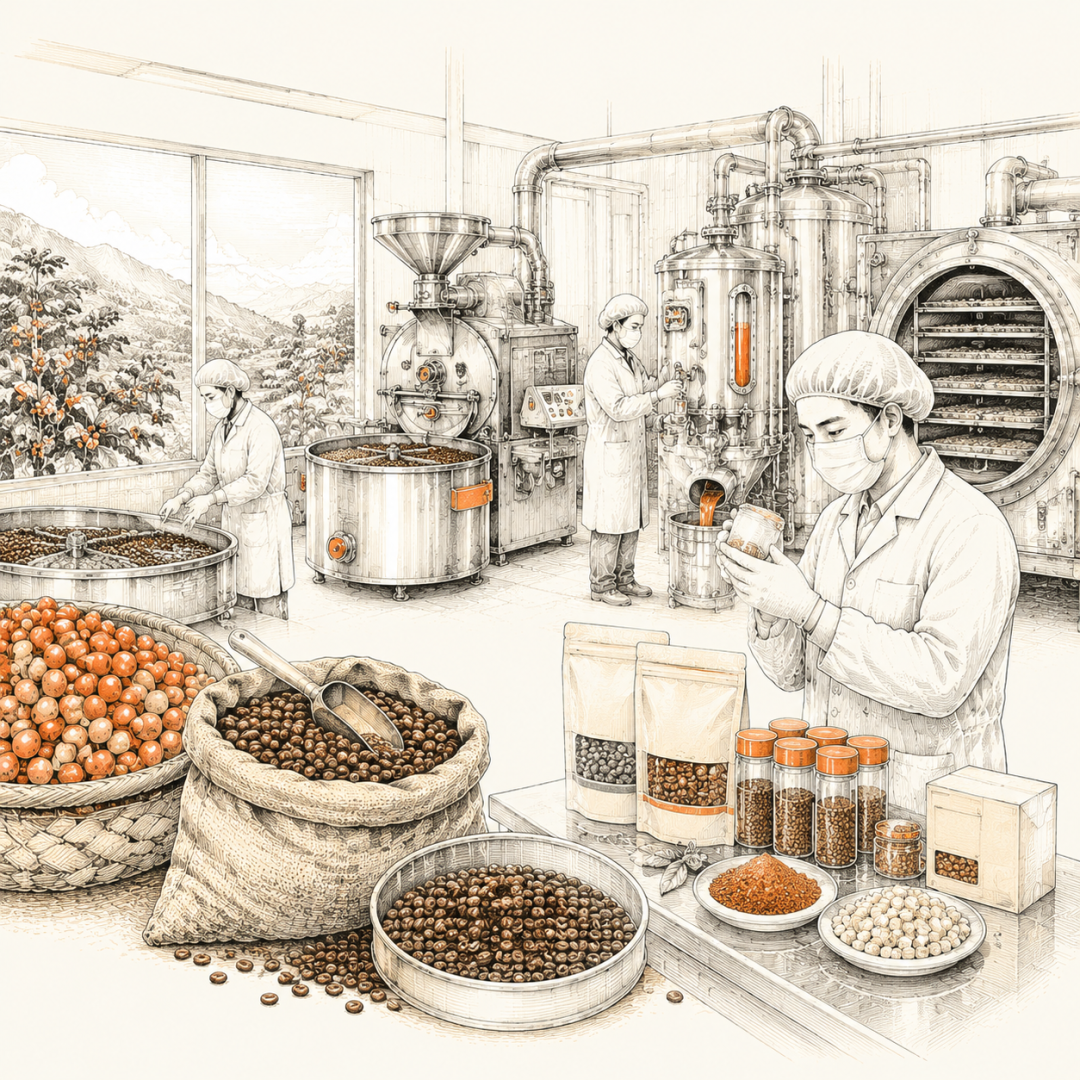
Figure · Jinglan's deep-processing chain — from green bean to 120+ innovative products
FOOD BOOTH OBSERVATION · Sample 04 / 04
Jinglan represents another Baoshan capability — deep processing. Traditional varieties reach higher value through both good cultivation and a mature processing system. Though its brand recognition is not high, this "backstage" capability is an important foundation of Baoshan's specialty industry: it keeps coffee's value from stopping at the green-bean stage.
·
Four companies, four capabilities
THE FULL PICTURE
The four companies show the capabilities an origin needs to build at different stages:
Link · Capability · Representative company
| Link | Capability | Representative company |
|---|
| Seed | Variety innovation | Zhongka — building its own-variety capability |
|---|
| Cultivation | Quality organization | Xinzhai — organizing a village for specialty |
|---|
| Consumption | Origin connection | Bidun — letting consumers enter the origin |
|---|
| Product | Value extension | Jinglan — keeping processing local |
|---|
The future of a cup of Baoshan coffee may not depend on any single company, but on whether these capabilities can form together.
FOOD BOOTH PUBLIC-INFORMATION OBSERVATION · Non-quality scoring
Each company's sufficiency of public evidence across six dimensions (origin identity through social responsibility):
Public-information maturity — four Baoshan coffee companies
| Company | P1 Origin identity | P2 Transparency | P3 Quality cert. | P4 Traceability | P5 Consistency | P6 Responsibility |
|---|
| Zhongka | Established | Established | Established | Developing | Established | Established |
|---|
| Xinzhai | Established | Developing | Established | Developing | Established | Established |
|---|
| Bidun | Established | Developing | Established | Developing | Established | Developing |
|---|
| Jinglan | Established | Developing | Established | Developing | Established | Developing |
|---|
Levels: Leading · Established · Developing · Starting (high to low). This table is an observation draft based on public information, not a quality score; each level is judged by the sufficiency of the company's public disclosures and has not yet been port-verified. It may be updated as public information changes.
Writing this article, I kept returning to one question: why do so many people know Blue Mountain and Kona, yet so few know Baoshan?
For decades Baoshan existed mainly as a raw-material origin, rarely telling its own story. But going back to history and variety itself, it preserves one of Yunnan's most complete sets of traditional arabica varieties and witnessed the early development of China's coffee industry; today, more and more companies are starting to use "Baoshan" as an origin brand.
In the first piece we discussed how Pu'er coffee built an origin identity through standards; in this piece we observed how Baoshan brings a cup of coffee closer to the consumer through variety, industrial organization, origin experience, and processing capability. To the consumer, both matter.
Food Booth's job is not to judge good from bad for the consumer, but to make the information as clear as possible. See you in the next issue.
FOR BUYERS · One line for procurement people
Food Booth focuses on public information and does not give procurement advice. Actual purchasing still requires comprehensive judgment combining specifications, certification, supply capacity, and commercial terms.
FOR READERS · One line for consumers
A cup of coffee can just be coffee. Liked for its flavor, chosen for its price — nothing wrong with that. What Food Booth hopes is that when you're willing to understand a bit more, there's another way to look at it: beyond flavor, there's origin; beyond brand, there's supply chain; beyond promotion, there's evidence.
||| END
Next issue: we'll also pay attention to Chinese foods that lack public understanding. Food Booth will keep using the same observation framework to study more Chinese foods.
Professional statement · Based on public company and government information
Food Booth focuses on the sufficiency of companies' public information, and on verifiable quality-management evidence — it does not guarantee a product's absolute quality or food safety.
This article is written based on publicly verifiable information as of July 2026. The author has not actually tasted the products discussed, so does not comment on specific flavor performance, nor does it constitute purchasing advice.
Company data primarily come from the Baoshan Municipal People's Government, the Baoshan Agriculture and Rural Bureau, the Baoshan Market Supervision Administration, relevant CNIPA announcements, as well as company websites, official accounts, and public interviews (incl. Xinhua Net Yunnan, Yunnan Daily, People's Daily Online, Farmers' Daily, Baoshan Release, etc.). Varietal descriptions are industry common knowledge, not independent testing conclusions by Food Booth.
- Baoshan Municipal People's Government · Baoshan small-grain coffee GI and industry-development public information (2024–2025) — origin holds national GI protection, 35 enterprises authorized to use the special mark, and other baseline data.
- Baoshan Agriculture and Rural Bureau · Annual coffee-industry reports and public notices (2024–2025) — planting area, specialty rate, leading-enterprise cultivation, and other industry data.
- CNIPA · GI Special Mark use announcements (2024–2025) — GI authorization info for Zhongka and other enterprises.
- Yunnan Daily · Baoshan Zhongka Food Co. report (2025) — "Xinlu" brand e-commerce sales, 2025 sales of ¥270 million, award as National Leading Agricultural Industrialization Enterprise.
- Xinhua Net Yunnan · Zhongka "Yunka No.1" new-variety report (2024–2025) — Zhongka with the Hot-Dry Regions Institute of the Yunnan Academy of Agricultural Sciences bred the IP-owned small-grain variety "Yunka No.1."
- Baoshan Release (Baoshan gov't news office) · Xinzhai Village coffee-industry transformation report (2024–2025) — "China's first coffee village," specialty green-bean prices, rising specialty rate, coffee-tourism fusion, village collective income.
- Farmers' Daily · Xinzhai Village specialty-transition report (2024) — graded picking, cooperative organization, farmer income growth, and other village industrial samples.
- Baoshan Release · Bidun Coffee Industry & Culture Park report (2024) — manor rated national 4A scenic area, annual visitors, primary-secondary-tertiary integration.
- People's Daily Online · Baoshan coffee-manor cluster report (2024) — number of Longyang specialty manors, Yunnan specialty-manor recognition.
- Kunming Customs · Yunnan coffee export statistics (2025) — Yunnan coffee (incl. Baoshan Jinglan) export categories and destinations.
- Baoshan Release · Yunnan Jinglan Tropical Crops report (2025) — deep-processed products, exports to 5 countries, agricultural-industrialization and high-tech enterprise qualifications.
- Company websites and official accounts (Zhongka / Xinzhai / Bidun / Jinglan) · public intro materials (as of July 2026) — each company's brand matrix, product system, capacity, and public traceability info.
Note: the above are summaries of public sources, without specific links; varietal descriptions are industry common knowledge, not independent testing conclusions by Food Booth.
THANKS FOR READING