FOOD BOOTH · Issue 005 · Coffee · Industry · 2026.07
The "small-grain" variety underestimated by its own name
Not about standards — let's talk about varieties first. How Baoshan tells its story with traditional arabica, as another path alongside Pu'er.
Baoshan Small-Grain Coffee · Industry Edition · Variety · Traditional arabica
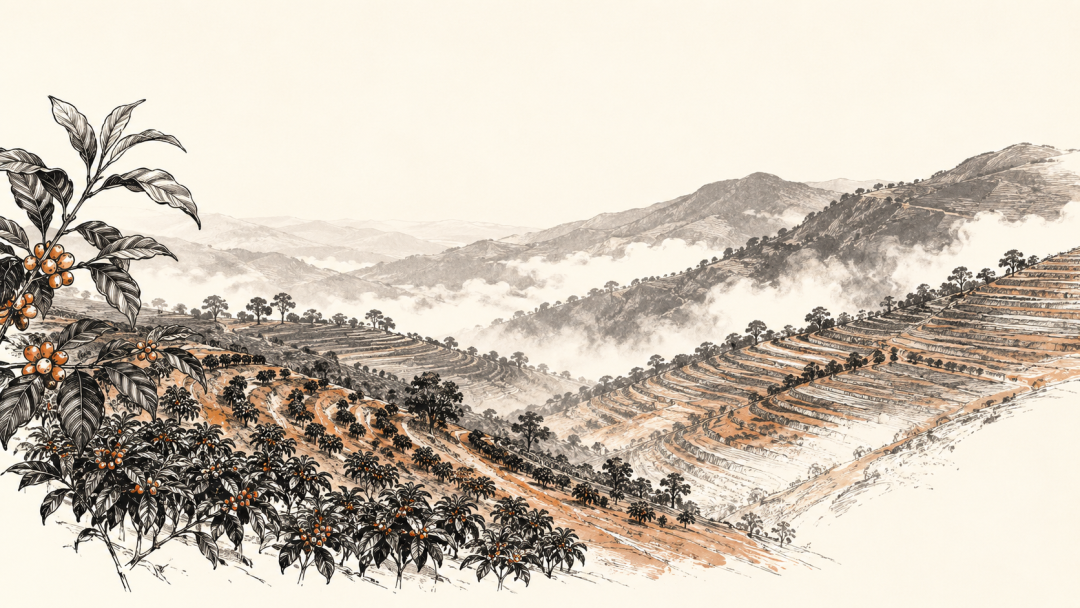
Figure · Baoshan small-grain coffee — a traditional arabica variety underestimated by its name
FOOD BOOTH'S POSITION · Public observation
Food Booth does not judge whether a company is good or bad; it only observes how sufficient its public evidence is.
In the #YunnanCoffee world, Baoshan and Pu'er are often named together as the two core origins. Walk into a supermarket, an e-commerce platform, or a livestream, and Pu'er coffee's presence is self-evident. But ask a long-time specialty drinker which beans are more representative, and many will point to Baoshan.
Much of this contrast comes down to one thing: the name "small-grain coffee."
"Small-grain coffee" was not named after bean size — it is the traditional Chinese term for arabica. Baoshan's most representative traditional variety, Typica (铁皮卡), is among the oldest traditional arabica varieties. In the 18th century it spread from Yemen to other parts of Asia, and later became the Typica-line source behind famous origins like Jamaica's Blue Mountain and Hawaii's Kona.
It is precisely the name that caused Baoshan coffee to be underestimated.
In Issues 001 and 002 we wrote about Pu'er coffee — how it took 12 years to move from a certification mark to a national standard (the Industry Edition and the Company Edition). This time, let's step outside the "standards" frame and talk about "varieties" first.
01
"Small-grain" does not mean small
WHERE THE NAME MISLEADS
Traditionally, China classified coffee into small-grain, medium-grain, and large-grain — "small, medium, large" refers to the plant and leaf morphology, not the size of the bean.
To distinguish it from the medium-grain coffee (robusta) planted early in Hainan, Yunnan gradually came to call its locally grown arabica "Yunnan small-grain coffee." The name first spread from Baoshan's Lujiangba.
That was the 1950s, when Lujiangba began planting Typica and other traditional arabica varieties at scale. The plants were relatively short with smaller leaves, so local farmers got used to calling it "small-grain coffee." Later, "Yunnan small-grain coffee" became the province-wide name for all arabica, and Baoshan — as the birthplace of the name — was gradually diluted.
Today many people know "Yunnan small-grain," but not necessarily that it was first closely tied to Baoshan.
02
Baoshan still holds one of Yunnan's most complete collections of traditional arabica varieties
WHAT IT KEPT WAS NOT JUST QUALITY, BUT GERMPLASM
The first planted in Baoshan's Lujiangba were Typica and Bourbon — the oldest traditional arabica varieties, known for layered flavor, bright acidity, and clean cups. They are also the base varieties behind many of the world's classic specialty origins.
But they share a common problem: low yield, weak disease resistance, high management cost.
By the 1990s, with coffee price volatility and industry upgrading, many farmers switched to Catimor (卡蒂姆), an arabica hybrid carrying Robusta genetics. Promoted rapidly in the 1980s for its disease resistance, high yield, and easy management — able to meet mass-production needs — it became the ideal raw material for instant coffee. To this day, most coffee gardens in Yunnan still grow Catimor.
Many of Yunnan's local traditional varieties thus gradually declined. Fortunately, Baoshan people did not fully abandon them.
A frequently cited example from public reports is Fan Qizuo (番啟佐), a "third-generation coffee farmer" in Lujiangba. From 2000 to 2007, as coffee prices stayed depressed, many farmers cut down their trees and switched crops — but he kept his old Typica trees, unwilling to let them go. In 2022, his Zuoyuan farm was selected into the first batch of Yunnan specialty coffee manors. That same year, at the Baoshan specialty green-bean competition, a non-washed Typica scored 89.175 — not only taking the championship, but exceeding that year's top score at the provincial Yunnan specialty competition, reshaping many people's view of Baoshan coffee.
Baoshan and Pu'er took different paths: Pu'er is more about how to build standards and form a system; Baoshan's path is how to keep a set of traditional varieties and regain market recognition.
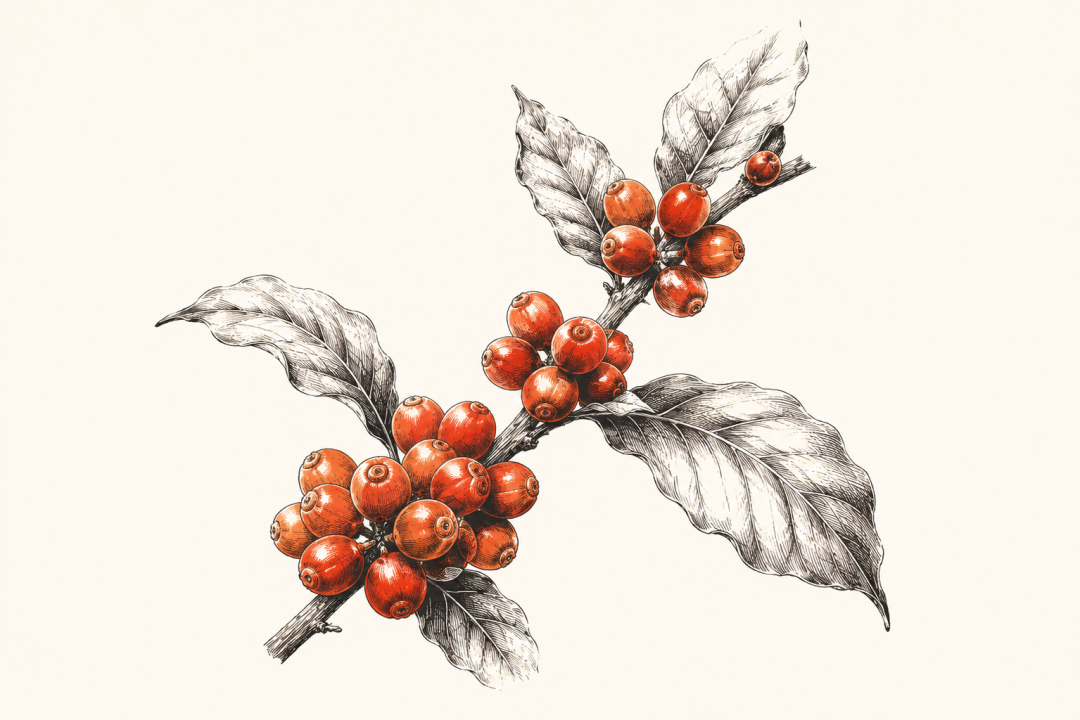
Figure · Baoshan's traditional arabica — Typica and Bourbon, kept alive through decades
03
130 years of accumulation
FROM ZHUKULA TO LUJIANGBA
In 1892, French missionary Tian Deneng introduced Typica in Zhukula, Binchuan, Yunnan — widely regarded as the beginning of coffee cultivation on China's mainland.
In 1952, Yunnan's agricultural research institutes brought coffee to Baoshan's Lujiangba for scaled trial planting, which succeeded and drove Yunnan's first round of coffee industrialization. Since then, Lujiangba gradually became one of China's important coffee origins, and it still preserves coffee trees decades old.
In 1958, Baoshan small-grain coffee was rated Grade 1 at the London International Coffee Tasting and named "Lujiang No.1."
Xinzhai village in Lujiangba later became known as "China's first coffee village" for its long history of cultivation. On this timeline, Baoshan looks less like a recently emerged specialty origin and more like the starting point of China's coffee industry.
04
From "raw-material origin" to "brand origin"
TURNING ACCUMULATION INTO BRAND VALUE
For a long time, Baoshan coffee played the role of raw-material supplier.
In 1988, Nestlé entered Yunnan, driving rapid local industry growth and gradually turning Yunnan into an important global raw-material base for instant coffee.
Scale grew, but two habits formed: first, planting more of the higher-yield, more stable Catimor; second, selling mainly green beans, leaving brand value downstream in the chain.
Baoshan was no exception. Large volumes of beans entered the market under the identity of "Yunnan coffee," but rarely sold directly as the "Baoshan" brand.
Pushing "Baoshan" as an origin brand to consumers has been a project of the last decade.
Baoshan coffee 2025
180,600 muPlanting area
26,800 tOutput
¥22.328 billionIntegrated output value
The specialty rate rose from under 10% (2020) to above 75%; the deep-processing rate rose from about 30% to above 90%.
05
How to identify a pack of Baoshan coffee
FOUR CLUES FOR CONSUMERS
First, look at the geographical indication. "Baoshan small-grain coffee" holds not only national geographical-indication protection, but was also included in the first batch of 100 Chinese geographical indications protected within the EU. More importantly, Baoshan now issues authorized enterprises a uniformly printed "Baoshan small-grain coffee" GI traceability label free of charge. Consumers can now do more than just look at the mark — they can scan a code to verify authenticity and view core information such as origin and quality standards, making anti-counterfeiting far more direct.
Second, look at the variety. If the package names Typica (铁皮卡) or Bourbon (波旁) — traditional varieties — it is closer to the traditional arabica germplasm Baoshan has long preserved. If it names the recently celebrated Gesha (瑰夏), it signals Baoshan's new push toward high-end specialty. If it names Catimor (卡蒂姆), that is the most widely planted variety in Yunnan today.
Third, look at the region. Baoshan sits between 24°N and 25°N, in the world's "coffee golden belt," with a unique dry-hot valley climate and volcanic-ash red soil. Lujiangba and the Gaoligong Mountain belt are the core growing areas of Baoshan's traditional arabica. If the package further names a specific village like Xinzhai — "China's first coffee village" — the traceability is even more precise and the flavor source clearer.
Fourth, also see the gaps. At present, most Baoshan GI enterprises have still not fully disclosed, to consumers, information such as batch, processing date, and plot source. Baoshan has advantages in variety and history, but in consumer-end information transparency there is still room to improve. That said, Baoshan has built the country's only national coffee-testing key laboratory with an SCA (Specialty Coffee Association) certified sensory lab, and has set the country's first "seed-to-cup" coffee standard system. This shows the authorities are actively pushing the whole industry toward standardization and transparency.
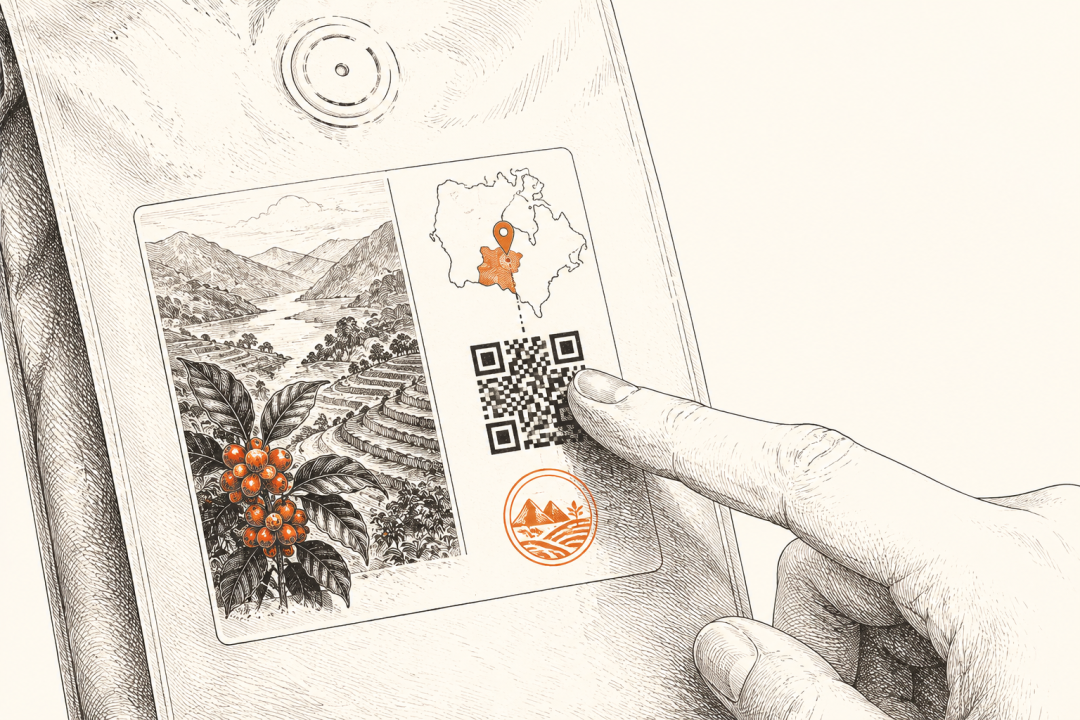
Figure · Baoshan small-grain coffee — from traditional variety to origin brand
Macro narratives at the industry level ultimately land through concrete companies. Among the 35 enterprises authorized to use the Baoshan small-grain coffee GI mark, I identified four representative samples; their specific stories I'll unfold in the next "Company Edition."
||| TO BE CONTINUED
Professional statement · Based on public company and government information
Food Booth focuses on the sufficiency of companies' public information, and on verifiable quality-management evidence — it does not guarantee a product's absolute quality or food safety.
This article is written based on publicly verifiable information as of July 2026. The author has not actually tasted the products discussed, so does not comment on specific flavor performance, nor does it constitute purchasing advice.
The descriptions of coffee varieties and historical threads (the 1892 Zhukula introduction, the 1952 Lujiangba scaled trial planting, and the characteristics of Typica, Bourbon, Catimor, etc.) are compiled from public industry materials, research literature, and media reports; the Fan Qizuo and Zuoyuan cases are drawn from public reporting.
- Baoshan Municipal People's Government. Reply to Proposal No. 028 of the 6th Session of the 5th Municipal CPPCC. 2025 — 2025 planting area 180,600 mu, output 26,800 tonnes, integrated output value ¥22.328 billion; specialty rate above 75%, deep-processing rate above 90%.
- General Office of Baoshan Municipal People's Government. Baoshan World Coffee Valley Development Plan (2024–2035). Issued 2025 — proposes the "5116" goal (500,000 mu planting, integrated output value above ¥60 billion by 2035).
- Xinhua Net Yunnan. "In Baoshan, watch small-grain coffee leverage a big industry." 2026-04-14.
- CNIPA. GI Special Mark User Database: Baoshan small-grain coffee authorized enterprises (35, as of July 2026).
- Xinhua Net. "Baoshan small-grain coffee | strong but not bitter, fragrant but not harsh." 2023-10-25 — included in the first batch of 100 Chinese GIs protected within the EU in 2021.
- People's Daily Online. "At the foot of Gaoligong, seeking a wisp of coffee aroma." 2025-09-18 — 1993 Brussels Eureka gold medal, 2010 national GI product, 2021 EU protection among the first 100.
- People's Daily Online Yunnan. "Yunnan Binchuan Zhukula: coffee blossoms fill the mountains." 2020-05-12 — 1892 French missionary Tian Deneng introduced coffee in Binchuan; Zhukula as the origin of Chinese coffee.
- Yunnan Provincial Museum. "Have you tasted coffee from century-old trees?" — 1892 Tian Deneng introduction; Zhukula still has 1,134 ancient coffee trees (24 over a century old).
- Southern People Weekly (Sun Lingyu, Wang Jiawei). "Yunnan coffee: the road to specialty amid the boom." 2022-03 — Nestlé's 1988 investment in Yunnan's coffee industry; Catimor promotion (Lujiangba nearly 180,000 mu).
- Baoshan Agriculture and Rural Bureau. Reply to Proposal No. 0030 of the 1st Session of the 5th Municipal CPPCC — 1952 introduction of Typica/Bourbon; Catimor above 95%; 7 standards including "GI Product — Baoshan Small-Grain Coffee"; among the first 100 of the China-EU GI agreement (ranked 3rd).
- Baoshan Municipal People's Government. "How Baoshan coffee broke out." 2025 — China's only national coffee-testing key lab with an SCA-certified sensory lab; the country's first "seed-to-cup" coffee standard system; brands like Zhongka / Bidun.
- Zuoyuan coffee manor and public reports on Fan Qizuo (Baoshan Release, Baoshan Agriculture and Rural Bureau; Baidu Baijiahao "Gesha, the 'new star' of the Baoshan small-grain family," 2023) — Zuoyuan selected into the first batch of Yunnan specialty manors in 2022; non-washed Typica scored 89.175 at the Baoshan specialty green-bean competition.
- Public reports on Baoshan coffee industry (Baoshan Release, Tencent News, etc.) — 1958 state-run Lujiang farm small-grain coffee rated Grade 1 in the London market, named "Lujiang No.1"; 1993 gold medal at the 42nd Brussels Eureka Expo in Belgium.
THANKS FOR READING