FOOD BOOTH · Issue 004 · Watermelon Special · 2026.07
Why can some watermelons only compete on price, while others get consumers to pay for the name?
From Henan watermelons going unsold, to whether China has watermelons "with a name people recognize" — an observation based on public information.
Watermelon Special · 8424 · Trust Network
FOOD BOOTH'S POSITION · Public observation
Food Booth does not judge whether a company is good or bad; it only observes how sufficient its public evidence is.
This summer, Henan watermelons trended on social media.
One grower said a bottle of mineral water could buy three watermelons; others simply gave up harvesting, because the more they sold, the more they lost. As the country's largest watermelon region, field-gate purchase prices in parts of Henan once fell to 0.1–0.3 yuan per jin (half a kilogram).
As news of #HenanWatermelonUnsold kept spreading, "buy-to-help-farmers" and "charity pre-order" campaigns appeared in various places, hoping to reduce growers' losses.
Public reports have already given plenty of reasons: good market conditions the previous two years led to expanded planting; warmer weather this year brought open-field watermelons to market at once, overlapping sales periods with Shandong, Anhui, Jiangsu, Hebei, and other regions; persistent rain disrupted storage and transport; and a typhoon warning triggered a round of concentrated dumping.
These reasons all hold.
But after researching a batch of watermelon-related entities, I think there's another question worth discussing: with the same watermelon, why can some only compete on price, while others get consumers to willingly pay for the name?
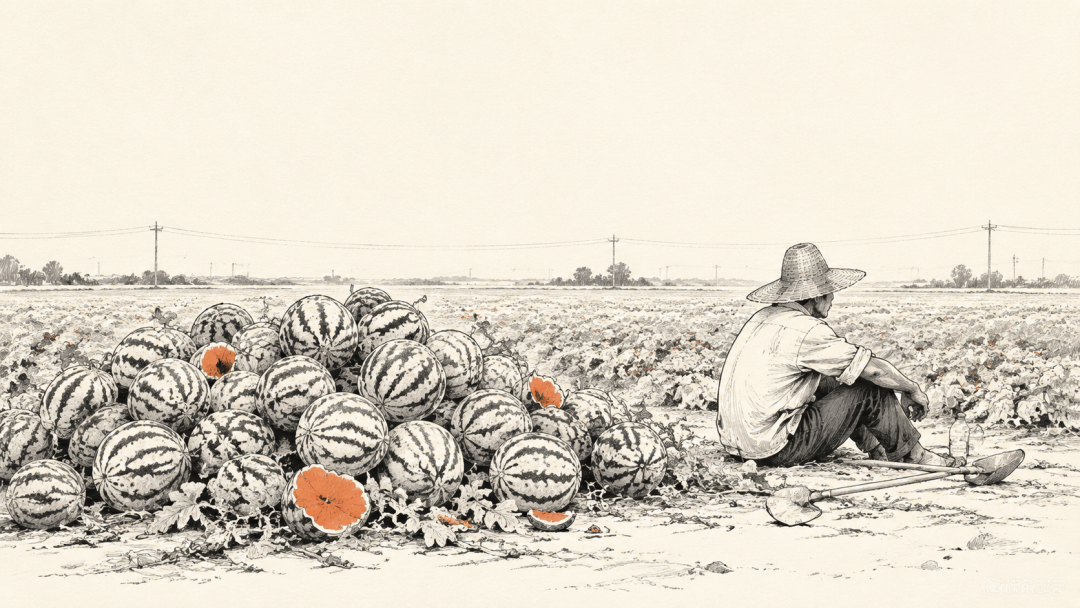
Figure 1 · Watermelons piling up in Henan fields, and a market where one bottle of water buys three melons
01
China is not short on "named" watermelons
NAMED WATERMELONS
Summer arrives, and on short-video platforms many old growers share tips for picking melons — look at the size, the stripes, heft it in your hand, slap it and listen. Everyone hopes to buy a thin-skinned, red-fleshed, sweet "reward melon."
Yet there are exceptions in the market: watermelons consumers trust and buy directly just from seeing the name.
China already has quite a few such watermelons.
#Nanhui 8424, #Dongtai watermelon, #Changle watermelon, #Lanzhou watermelon, #Ningxia selenium-sand watermelon … behind each name is a long-cultivated region with accumulated, stable market recognition. Many of these regional brands grew on the back of origin-protection systems such as geographical indications.
Here, three easily-confused concepts: #8424 is a watermelon variety, also widely grown in many of Henan's main regions; Nanhui 8424 is a regional brand formed in Shanghai with geographical-indication management; "Qilin melon" (Kirin) is a commercial brand that can be organized across different regions. They represent variety, regional brand, and commercial brand respectively — three different management approaches.
You could say that with the same watermelon, some are only a variety name, while others gradually become a brand consumers actively seek out.
The "name" mentioned in this article refers to regional brands like "Nanhui 8424." It represents not just a region, but long-accumulated brand management, origin protection, and market recognition. Henan, too, has regional brands such as Xiayi, Tanghe, Likou, Mengjin, Fugou, and Zhongmu — so the gap is not whether there's a name, but whether behind those names a continuous, verifiable, market-recognizable trust system has been built. This is the question this article really wants to answer: with regional brands all around, why do some become brands consumers actively seek, while others haven't formed the same market recognition?
Representative regions and typical watermelons
Representative regions and typical watermelons
| Region | Regional brand | Typical variety & form |
|---|
| Shanghai-Nanhui | Nanhui 8424 | Early-ripe 8424; medium round fruit, dark-green base with narrow dark-green stripes, red flesh. |
|---|
| Jiangsu-Dongtai | Dongtai watermelon | Mainly early-ripe varieties like 8424; round fruit, green base with stripes. |
|---|
| Shandong-Changle | Changle watermelon | Mainly facility cultivation, represented by Qilin-series and 8424; round or oval fruit, light-green stripes. |
|---|
| Gansu-Lanzhou | Lanzhou watermelon | Traditional large-fruit type; long-oval or near-round, light-green skin, red sandy-sweet flesh. |
|---|
| Ningxia-Zhongwei | Zhongwei selenium-sand watermelon | Gravel-mulched watermelon; large round fruit, grey-green skin, grown on gravel-covered fields. |
|---|
02
Why I chose Nanhui 8424 as the sample
WHY NANHUI 8424
To answer why Henan watermelons can't fetch a price, you first need a comparable sample. I chose Nanhui 8424.
The reason is simple: Henan regions like Xiayi and Shanghai's Nanhui both widely grow the 8424 variety. The same variety took two different paths. Parts of Henan fell into oversupply, while Nanhui 8424 gradually became a nationally known regional brand.
8424 was originally just a breeding code. In 1984, the team of academician Wu Mingzhu bred "Early-ripe 8424." "84" is the year bred, "24" the trial-combination number. In 1989, the variety was introduced to Shanghai's Nanhui for trial planting and gradually became the local main variety.
Decades on, what the market truly remembers is no longer just the 8424 variety, but the regional brand "Nanhui 8424." Around it, the locality gradually built unified brand management, origin protection, and a geographical-indication management system. Today, only products meeting the prescribed region and authorization requirements may use the name "Nanhui 8424."
Growing the same 8424, Henan sells the variety; Shanghai's Nanhui sells the brand.
That is why I use Nanhui 8424 as the comparison sample.
03
After checking a batch of companies, the gap became concrete
71 ENTERPRISES
To see where the gap actually comes from, I reviewed the public information of 71 entities, covering Shanghai's Nanhui, Jiangsu's Dongtai, and Henan's 6 watermelon geographical-indication regions — including certification, traceability, official websites, public company materials, and business-registry disclosures.
The whole observation looks only at publicly verifiable evidence — no scoring, no ranking.
Layer 1: Capability
From public materials, neither side lacks basic capability.
Nanhui 8424 is jointly used by 33 alliance members under unified management led by the Pudong Farmers Association; Henan has 25 mark-using entities across Xiayi, Tanghe, Likou, Mengjin, Fugou, and Zhongmu.
Both sides have plenty of "hard evidence." Nanhui's leading entities hold green-food certification, ISO systems, national demonstration cooperatives, and self-built traceability systems; Henan also has strong entities — for example, Mengjin Huilinyuan holds national demonstration-cooperative and green-food certification, Luoyang Nongfa built a provincial watermelon-breeding engineering research center, and Xiayi Gaoxiang disclosed expert-evaluated yield-per-mu and sugar-content data.
The key to the gap is whether these capabilities can be successfully turned into market value. Most Nanhui entities have an official website, e-commerce platform, or brand entry point; among Henan's 25 entities, this research found only 1 with a normally accessible company website. Many capabilities already exist, yet remain stuck in government announcements, media reports, and application materials — hard for consumers and buyers to see directly.
Layer 2: Verifiability
This is the most visible layer of the gap. Nanhui 8424 fully implements "one code per melon": consumers scan to query the producing entity, seed source, and records via the "Shen Nong Chain"; Dongtai also connects entities to the county-level traceability platform. Among the 25 Henan entities researched, none provided a consumer-direct traceability entry.
Moreover, the Nanhui alliance pushes product consistency to an extreme of openness through unified technology, standards, quality, trademark, packaging, and guide price. Most Henan entities still have low voluntary disclosure. This is not a lack of capability, but a lack of an information entry that lets the market perceive it directly — so much real capability fails to convert into consumer-"visible" transparency.
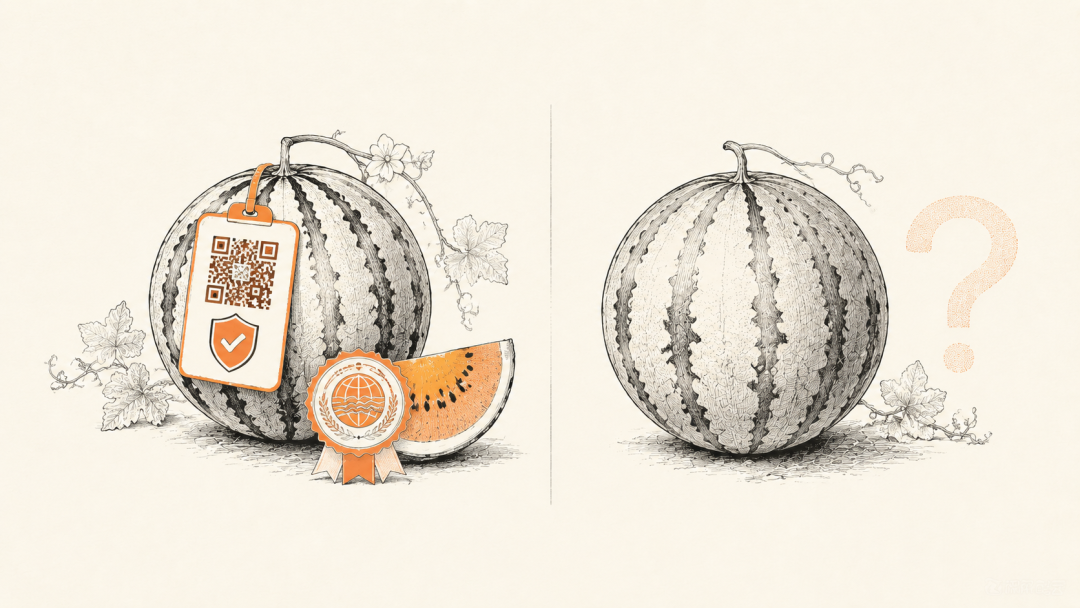
Figure 2 · Nanhui 8424's traceability code and geographical indication, against a melon with no queryable entry
Layer 3: Accumulating trust, forming a brand
Layer 2 solves "visible"; Layer 3 tests the long-term deposit of "trustworthy."
Nanhui 8424's moat lies not only in the scale of its 33 alliance members, but in this standardization mechanism running year after year. "One code per melon" is not just a check tool, but a trust contract letting consumers re-verify the same set of standards and the same evidence every year.
Henan also has deep industrial roots: Luoyang Nongfa developed 64 new varieties and promoted them across 3.72 million mu; Fugou Jinyuan raises 3 million seedlings per year in two cycles; Mengjin Huilinyuan involves 1,600+ farm households; Xiayi Gaoxiang also disclosed expert-evaluated yield and sugar content. Yet these capabilities are still scattered point-by-point across different entities, not yet woven into a region-wide, externally visible, verifiable system — hard to form a combined force that deposits into a regional brand.
Then, do the entities behind these regional brands have public food-safety problems? So I went on to search the public regulatory records of the 8424 sample entities.
Public-information profiles of eight entities
1Nanhui 8424 alliance leaders "Yueya · Taoyong · Lingshan · Tianbo" Shanghai Nanhui · Regional brand
Sample 1 / 2 · Regional brand · alliance member
All four are representative members of the "Nanhui 8424" watermelon brand cooperative alliance, managed under the Pudong New Area Farmers Association, guided by the Pudong agriculture-rural committee, practicing the "six unifications": unified technology, standards, quality, trademark, packaging, and retail guide price. Alliance members share the same set of planting standards and quality-control processes; the quality baseline is collectively guaranteed by the alliance.
When buying, consumers look for the "Nanhui 8424" regional brand and the geographical-indication special mark, scan the "Shen Nong Chain" code on the melon, and can view full-process data such as producing entity, seed-source information, inspection records, and harvest time.
2Henan mark-using group "Huilinyuan · Luoyang Nongfa · Xiayi Gaoxiang · Fugou Jinyuan" Henan · Mengjin / Xiayi / Fugou
Sample 2 / 2 · Demonstration cooperative · Green certification · Seed industry
All four are Henan geographical-indication mark-users: Huilinyuan is a national demonstration cooperative with green-food certification; Luoyang Nongfa built a provincial breeding engineering center; Xiayi Gaoxiang disclosed yield-per-mu and sugar-content data; Fugou Jinyuan is a regional seedling-supply node. Their capabilities are not weak, and many sit upstream in the chain. When buying, look for each region's geographical indication under "Henan watermelon" and check the authorization list — more direct than memorizing company names, since their end-user traceability entries are still limited.
APPENDIX · Public-maturity observations on the eight entities
Food Booth observes the sufficiency of these entities' public evidence across six dimensions (origin identity through social responsibility). Most Nanhui alliance leaders are "established"; Henan mark-users mostly fall between "developing" and "starting."
Public-information maturity — eight watermelon entities
| Entity | Origin identity | Transparency | Quality cert. | Traceability | Consistency | Responsibility |
|---|
| Yueya | Established | Established | Established | Established | Established | Established |
|---|
| Taoyong | Established | Established | Established | Established | Established | Established |
|---|
| Lingshan | Developing | Developing | Developing | Established | Developing | Developing |
|---|
| Tianbo | Established | Established | Established | Established | Established | Established |
|---|
| Huilinyuan | Developing | Developing | Developing | Starting | Developing | Developing |
|---|
| Luoyang Nongfa | Established | Established | Established | Starting | Established | Established |
|---|
| Xiayi Gaoxiang | Developing | Developing | Developing | Starting | Developing | Developing |
|---|
| Fugou Jinyuan | Developing | Developing | Developing | Starting | Developing | Developing |
|---|
Levels: Leading · Established · Developing · Starting (high to low). This table is an observation of public-information maturity, not a quality ranking; Food Booth does not judge whether an entity is good or bad, only observes how sufficient its public evidence is. Levels are judged from each entity's public materials as of the search date; entities may supplement public information according to the standard on their own.
04
What does the public information tell us?
WHAT THE RECORDS SHOW
Searching the public regulatory and corporate-credit data of 33 8424 geographical-indication mark-users (29 Nanhui, 4 Dongtai), no failed food-safety sampling records or related administrative penalties for watermelon products were found. Among deeply searched entities, negative records involved only routine business matters such as tax and civil disputes — no pesticide-residue or illegal-additive food-safety issues.
This mainly benefits from the system's long-term risk-management mechanism: the Nanhui alliance unifies planting management and conducts pre-market residue sampling; Dongtai likewise relies on its traceability platform for strict control, achieving not only a 100% multi-year sampling pass rate, but in an April 2026 "testing to the field" campaign by its market regulator, an extremely fast CMA-authorized test report within 3 days.
The noise in public cases comes from multiple external incidents of counterfeit "Nanhui 8424" sold under false origin. Therefore, the consumer end needs to look for the geographical indication and traceability code to confirm whether the melon truly comes from the claimed region.
Note: the above conclusions are based on public-information searches and do not represent a full investigation; absence of records does not equal zero risk.
05
Where exactly is the gap?
THE GAP
After this round of research, I increasingly feel that behind price competition is actually trust competition.
The same 8424: if buyers and consumers can't see the origin, standards, traceability, and producing entity, it can only enter price competition as an ordinary commodity; conversely, when this information can be continuously verified, the market is more willing to pay a brand premium for it.
06
May every melon you buy be ripe and sweet
BEFORE YOU BUY
Before writing this, I thought Henan watermelons were about supply and demand; after this round, I found they're also about market trust. But that doesn't mean you should only buy by brand. Most people buy melons by whether they're sweet, ripe, worth the price. A regional brand, geographical indication, and traceability code won't make a melon sweeter — they just make it easier to know: where this melon came from, who grew it, why it's worth trusting.
A region can have good varieties, good technology, good quality. But only when these capabilities are continuously seen and continuously verified do they stand a better chance of becoming a name consumers remember.
Food Booth · Two more questions when buying watermelon
If you're willing to understand a bit more, you might as well ask two questions when buying:
- What melon is this?
- What else can I find out about it?
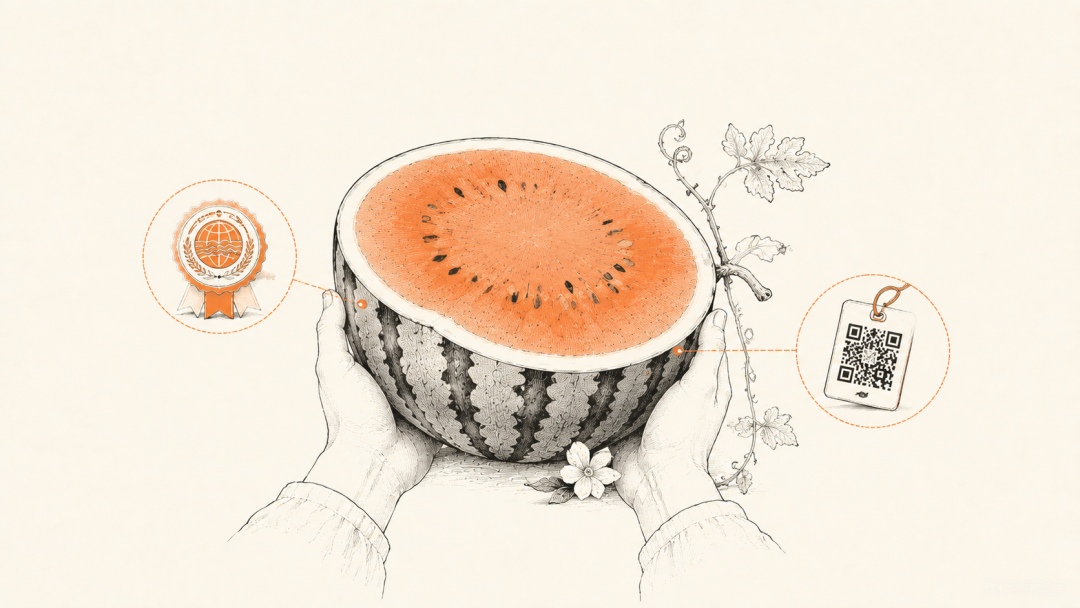
Figure 3 · Back to the melon in your hand — recognize the mark, check the traceability
This is also what Food Booth has always wanted to do. Not to endorse companies, but to translate the information in public materials into judgment criteria that consumers and buyers can both understand and use.
May every melon you buy be ripe and sweet. The name just gives you a bit more certainty. A good melon deserves to be recognized.
FOR BUYERS · One line for procurement people
Food Booth focuses on public information and does not give procurement advice. Actual purchasing still requires comprehensive judgment combining specifications, certification, supply capacity, and commercial terms; this article's maturity observations only help you shorten the time to check public information.
FOR READERS · One line for consumers
A melon can be liked just for being sweet, chosen just for being cheap — nothing wrong with that. What Food Booth hopes is that when you're willing to understand a bit more, there's another way to look at it: beyond price, there's origin; beyond name, there's evidence; beyond promotion, there's what you can look up.
||| END
Next issue · We'll also pay attention to Chinese foods that lack public understanding
Food Booth will keep using the same observation framework to study more Chinese foods.
Professional statement · Based on public company and government information
Food Booth conducts research and organization based on public information from companies and governments. What we care about is the sufficiency of public information, and the verifiable evidence formed by quality management, supply-chain governance, and industry practice.
The company cases in this article represent only information publicly available as of July 2026, and do not constitute a guarantee of product quality, safety, or commercial value, nor any procurement or investment advice.
The author of this article has not accepted any form of commercial sponsorship or paid promotion from the companies mentioned.
- CNIPA Geographical-Indication Special Mark User Database: public GI information for Nanhui 8424, Dongtai watermelon, Changle watermelon, Xiayi watermelon, Mengjin watermelon, Fugou watermelon, etc. (as of July 2026)
- Shanghai Pudong New Area Farmers Association "Nanhui 8424" brand management and "one code per melon" traceability public materials
- Dongtai watermelon traceability platform public data (2023 pesticide-residue non-detection rate 98.6%)
- National Enterprise Credit Information Publicity System; SAMR food-safety sampling notices and administrative-penalty public information
- Public news reports on Henan watermelon oversupply (summer 2026) and Henan Provincial Department of Agriculture and Rural Affairs planting-structure and monitoring-warning public information
- Academician Wu Mingzhu's team "Early-ripe 8424" breeding public materials (bred 1984, introduced to Shanghai Nanhui 1989)
- Public disclosures from each company's website, official account, and e-commerce platform (as of July 2026)
THANKS FOR READING