FOOD BOOTH · Issue 002 · 2026.07
Four development paths of Pu'er coffee, four capability samples
Reading four companies' four kinds of capability from their public information. What's worth attention isn't which company is best, but how much verifiable information each leaves behind.
Case Review · Issue 002 · Company Edition
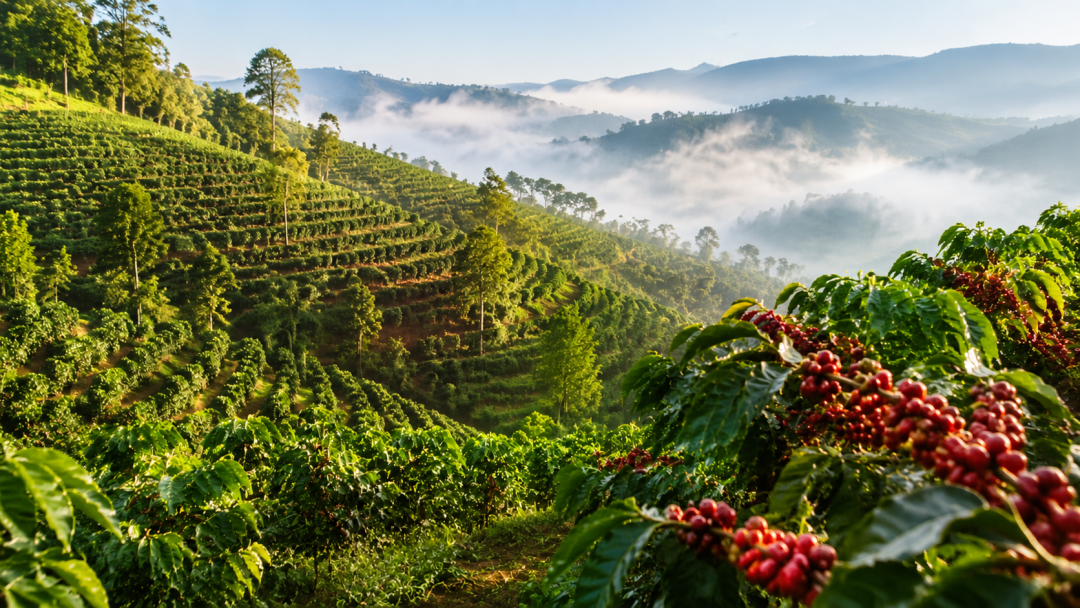
In the previous piece, we talked about the development of Pu'er coffee and the birth of its national standard. From Nestlé's entry into Yunnan in 1988 to the standard's release in 2025, that was a full 37 years.
Beyond the national standard, what I wanted to know more was: what have these companies actually been doing all these years?
I reviewed the public information of 15 Pu'er coffee companies. Their development paths are not the same: some have preserved varietals over the long term, some run estates, some organize cooperatives, and some go deep on the supply chain. The four most worth watching represent four different paths.
1Aini A question about long-termism
Sample 01 / 04
If I had to pick one company to represent long-termism, I'd pick Aini. This company has spent a lot of time on something with no short-term return — preserving coffee varietals.
Public records show that Aini Estate has built a germplasm repository containing 114 coffee varieties. Many companies watch this year's yield and cupping scores; germplasm is about the future. Keeping more varieties gives the whole origin more options when climate, pests, or markets change.
Beyond varietals, Aini also holds China organic certification, EU organic certification, and Rainforest Alliance certification. As a supply partner to Starbucks in Asia-Pacific, its cultivation and processing passed C.A.F.E. Practices audits. In 2024 and 2025 it won the washed-category championship (Geisha, cupping score 87) at the Yunnan Green Coffee Bean Competition for two consecutive years, and was named among the "Top 10 Specialty Coffee Estates of Yunnan."
Certifications can be earned in a few years; a germplasm repository takes many years of steady accumulation. This information shows a long-horizon way of operating. Aini discloses fairly complete origin information: estate, varieties, altitude, and certifications are all findable; if it goes further and discloses each batch's Lot Number, processing date, and processing details, the long-term value of this germplasm repository will also be easier for consumers to understand.
2Xiao Aozi A question about transparency
Sample 02 / 04
If Aini showed me long-term investment, then Xiao Aozi showed me another kind of capability: disclosure.
From its website and official account to third-party platforms, you can find ongoing records of the estate, cultivation, processing, and operations; visitor reviews on Dianping and Ctrip provide another layer of evidence. How a company describes itself is one thing; what the outside world actually sees matters just as much. Staying transparent makes public information easier to discuss and verify, and lets the outside world form its own judgment.
Public records show that Xiao Aozi has long run coffee varietal trials, preserves the traditional firewood-roasting craft, and at the same time introduced modern processing equipment. In 2023 it became one of the Rainforest Alliance group-member farms, and in 2024 it was named among Yunnan's 14 provincial-level specialty coffee estates. The estate has now introduced more than 50 varieties and developed deep-processed products such as coffee-cascara tea. Its new specialty production line, launched in 2025, proposes "clear batches, full traceability" — a sign the company is moving toward finer batch management and traceability.
The estate was among the earlier in Pu'er to explore the coffee-tourism blend. Like the other three, Xiao Aozi also practices ecological cultivation and has avoided chemical agents for over two decades.
Xiao Aozi's biggest trait is its willingness to keep disclosing these practices. Leaving information that companies often treat as internal — varietal trials, processing batches — open to the public is what sets it apart from many peers. Its boundary is equally clear: a 300-mu estate has limited scale, and whether its experience can be replicated at larger scale remains an open question for the industry; if it keeps disclosing larger-sample batch data, the outside world's judgment will also become more reliable.
3Beigui A question about historical depth
Sample 03 / 04
Beigui represents another kind of value: time. Public records show the company was founded in 1988, earlier than Starbucks' entry into the Chinese market. Its ecological coffee garden exceeds 6,000 mu, at an altitude of 950–1,350 meters. "Beigui" comes from the Tropic of Cancer — the company name itself carries the origin's imprint.
Cooperatives, fair trade, ecological coffee gardens, and wastewater treatment — all familiar today — meant higher investment and more experimentation three decades ago. Public records show Beigui holds 3 green-food mark certifications and 3 self-developed patents, and independently developed a wastewater environmental-protection system processing 100 tons of fresh fruit per day; it was also among the earlier Chinese coffee companies to obtain international Fairtrade certification.
In 2012, Shenzhou-9 carried 60 grams of Pu'er coffee seeds into space, orbiting for 13 days before returning to Earth. The subsequent seedling and trial work was undertaken by Beigui. At the same time, it joined with 17 cooperatives to implement a price-floor purchasing policy, helping about 3,000 farm households increase their income.
Beigui is not short on public information; rather, that information is scattered across its website, mini-program, and business-registry platforms, lacking a consistently maintained unified entry point — so decades of accumulation are hard to see.
4Jinshu A question about the "hidden champion"
Sample 04 / 04
Compared with estate brands, Jinshu represents another kind of company in the supply chain. Many consumers have long consumed products processed by Jinshu without knowing much about the processor itself. Public records show Jinshu is a processing company integrating cultivation, hulling-and-sorting, and roasting, and is also one of Pu'er's local provincial-level leading enterprises; it maintains long-term cooperation with deep-processing companies such as Yunnan Jinkelong, and its products enter the domestic market and are exported to more than 30 countries and regions including Singapore and Germany. Such companies rarely appear in consumers' view, yet they play an important role connecting the cultivation end with the market.
Public records show Jinshu has long gone deep on processing and supply-chain links, building a fairly complete certification system including Rainforest Alliance, green food, and 4C, reaching specialty grade in provincial cupping, and involving more than 500 farm households in industry development.
Jinshu is more like a supply-chain company than a consumer brand. From cultivation, hulling-and-sorting, to roasting, it has deposited its capability in processing and export; its products reach more than 30 countries and regions, yet it almost never appears directly on consumers' shelves or menus. This "invisibility" is not a capability problem — it's that the information accumulated at the production end hasn't yet been translated into a language consumers can read.
01
Why it's worth attention
Four paths, pointing in the same direction
The four companies represent four different development paths: long-term investment, public transparency, historical accumulation, and supply-chain capability. The common point is also clear — all treat ecological cultivation as a long-term practice. The real difference isn't whether they have ecology, but which verifiable information they disclose.
What the four companies disclose most fully is still basic information such as origin, estate, and certifications. Internationally leading companies have gone further, disclosing batches, processing, and trade information, so consumers can independently verify the source of a bag of coffee.
International benchmarks · how far have they disclosed?
Onyx Coffee Lab — For every bean, it discloses retail price, green cost, FOB price, farm-gate price, batch weight, and cupping score.
Counter Culture Coffee — Has published a transparency report every year since 2009, disclosing partner count, purchase volume, and FOB price ranges.
Nucoffee (Syngenta) — Uses a QR code to connect each batch's farm and processing information to consumers' phones.
02
How Food Booth observes a company
Transparency maturity: a capability ladder
What Food Booth cares about is not whether a company is good or bad, but the maturity of its public evidence. From a company intro, to certifications, estate, and Lot Number, to QR code, trade price, and transparency report — each step forward gives consumers more independently verifiable information.
DATA · Observations on the four companies' public-information maturity
Public-information maturity — four Pu'er companies
| Company | Origin identity | Transparency | Quality cert. | Traceability | Consistency | Responsibility |
|---|
| Aini | Leading | Established | Leading | Developing | Leading | Starting |
|---|
| Xiao Aozi | Established | Leading | Established | Established | Established | Established |
|---|
| Beigui | Leading | Established | Established | Starting | Established | Leading |
|---|
| Jinshu | Starting | Starting | Leading | Starting | Established | Established |
|---|
Levels: Leading · Established · Developing · Starting (high to low). This table is an observation of public-information maturity, not a quality ranking; Food Booth does not judge whether a company is good or bad, only observes how sufficient its public evidence is. Levels are judged from each company's disclosed materials; companies may supplement public information according to the standard on their own.
DATA · Transparency maturity ladder (L1–L7)
Transparency maturity: a capability ladder — L1 Intro · L2 Certification · L3 Estate · L4 Lot · L5 Code · L6 Price · L7 Report. Most Chinese companies stop at the first few levels (L1–L5); L6–L7 are international benchmarks (Onyx / Counter Culture).
Transparency maturity ladder
| Level | What it discloses |
|---|
| L1 · Intro | Discloses "who I am" — name, location, rough business. |
|---|
| L2 · Certifications | Varieties, estate, altitude, certifications, cupping score. |
|---|
| L3 · Estate | Opens the estate to the public, leaving ongoing records. |
|---|
| L4 · Lot Number | Each batch's processing information is findable. |
|---|
| L5 · QR-code lookup | Consumers scan with their phone to reach farm and processing info. |
|---|
| L6 · Trade price | Onyx discloses retail price, green cost, FOB price, farm-gate price. |
|---|
| L7 · Transparency report | Counter Culture has done so every year since 2009. |
|---|
Food Booth's articles don't judge products; they judge evidence.
03
One line for procurement people
To shorten your information-gathering time
Food Booth focuses on public information and does not give procurement advice. Actual purchasing still requires comprehensive judgment combining specifications, certification, supply capacity, and commercial terms.
04
One line for consumers
Another way to look at it
A cup of coffee can just be coffee. Liked for its flavor, chosen for its price — nothing wrong with that. What Food Booth hopes is that when you're willing to understand further, there's another way to look at it: beyond flavor, there's origin; beyond brand, there's supply chain; beyond promotion, there's evidence.
/// END
Next issue · We'll also pay attention to Chinese foods that lack public understanding
Food Booth will keep using the same observation framework to study more Chinese foods.
Professional statement · Based on public company and government information
Food Booth conducts research and organization based on public information from companies and governments. What we care about is the sufficiency of public information, and the verifiable evidence formed by quality management, supply-chain governance, and industry practice.
The company cases in this article represent only information publicly available as of July 2026, and do not constitute a guarantee of product quality, safety, or commercial value, nor any procurement or investment advice.
Some historical materials come from public reports, and differences in wording may exist between sources. If companies or institutions provide new public information, Food Booth will continue to update related content.
The author of this article has not accepted any form of commercial sponsorship or paid promotion from the companies mentioned.
- Geographical Indication Product Quality Requirements — Pu'er Coffee (GB/T 45690-2025)
- Pu'er Market Supervision Administration: "Pu'er Coffee: From Geographical Indication Cultivation to Whole-Chain Co-governance Empowerment" (2025 "Promoting Food Safety Social Co-governance" Top 10 Case)
- China Media Group (CCTV News) public reports on Yunnan's coffee industry
- Public materials from Pu'er Municipal People's Government and Yunnan Provincial Department of Agriculture and Rural Affairs
- Official websites and publicly released information of each company (as of July 2026)
- Coffee-industry public reports (Nespresso's 2003 use of Yunnan coffee beans)
- Brand-value data: 2025 China Brand Value Evaluation Release (China Geographical Indication Product Regional Brand Value Evaluation List)
- International reference: Onyx Coffee Lab product-page transparency information (retail price / green cost / FOB price / farm-gate price / batch weight / cupping score), onyxcoffeelab.com
- International reference: Counter Culture Coffee "Transparency Report 2025" (published annually since 2009), counterculturecoffee.com
- International reference: Nucoffee (Syngenta) QR-code coffee traceability platform, nucoffee.com
THANKS FOR READING